
Vehicle Market Value API: Dealer, Trade & Private Values
Get accurate trade-in, private party, and retail values for any vehicle in seconds. Send a VIN or year, make, and model and get back pricing based on vehicle condition, mileage, and state. US vehicles, 1981 to present.
How the Car Value API Works
Getting a full pricing breakdown with the car value API takes three steps. They are:
Step 1: Send a VIN or Vehicle Details
Call the API with a 17-character VIN or with year, make, and model, along with the mileage and US state.
Step 2: The API Resolves the Vehicle and Pulls Pricing
The API identifies the vehicle and calculates market values using current sales data and condition.
Step 3: Receive Structured JSON
Get trade-in, private party, and dealer retail values for every condition tier back in one response, ready to use without any additional formatting.
What Is a Vehicle Market Value API?
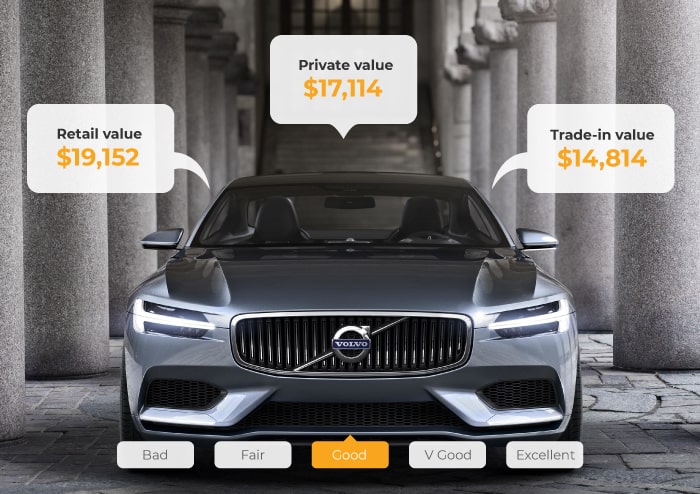
A vehicle market value API returns what a specific vehicle is actually worth. Instead of pulling a single number off a static chart, you send a request with a VIN or a year, make, and model, and the API returns real pricing based on market trends, dealer sales, and transaction data across North America.
This is different from a basic car price API that only gives you one flat figure. Ours accounts for condition, mileage, and location, since the same vehicle can be worth thousands more or less depending on all three.
API Coverage & Support
Region |
Model Years |
Lookup Methods |
Required Inputs |
|---|---|---|---|
| US vehicles | 1981 to present | 17-character VIN or Year, Make & Model | Current mileage and US state |
Why Choose Vehicle Databases’ Market Value API?
The Vehicle Databases Market Value API helps to retrieve reliable vehicle valuations without relying on manual research or multiple pricing sources. Here are a few reasons to build with our API:
Accurate Market Values
Value Vehicles by VIN or Year, Make, & Model
Structured JSON
Instant Responses
Integrate in Minutes
Built to Scale
Production-Ready Infrastructure
Developer-Friendly Experience
What Data Does the Car Valuation API Return?
Vehicle Information
- VIN
- Year
- Make
- Model
- Trim
- Mileage
- State
Market Values
- Trade-In Value
- Private Party Value
- Dealer Retail Value
Vehicle Condition
- Outstanding
- Clean
- Average
- Rough
Example Market Value Response
					{
        "status": "success",
        "data": {
            "intro": {
                "vin": "WBAPH7G50BNM56522"
            },
            "basic": {
                "make": "BMW",
                "model": "328",
                "year": "2011",
                "trim": "i 4dr Rear-wheel Drive Sedan Manual",
                "state": "NY",
                "mileage": "12,000"
            },
            "market_value": {
                "market_value_data": [
                    {
                        "trim": "i 4dr Rear-wheel Drive Sedan Manual",
                        "market value": [
                            {
                                "Condition": "Outstanding",
                                "Trade-In": "$6,829",
                                "Private Party": "$12,153",
                                "Dealer Retail": "$15,200"
                            },
                            {
                                "Condition": "Clean",
                                "Trade-In": "$6,483",
                                "Private Party": "$11,473",
                                "Dealer Retail": "$14,273"
                            },
                            {
                                "Condition": "Average",
                                "Trade-In": "$5,906",
                                "Private Party": "$10,341",
                                "Dealer Retail": "$12,727"
                            },
                            {
                                "Condition": "Rough",
                                "Trade-In": "$5,157",
                                "Private Party": "$8,869",
                                "Dealer Retail": "$10,719"
                            }
                        ]
                    }
                ]
            }
        }
    }
Instantly Retrieve Vehicle Values Without Integration
Need vehicle values today but not ready to integrate the API? Sign up and use the Market Value API directly from your dashboard to retrieve trade-in, private party, and dealer retail values with just a VIN.
Trade-In vs. Private Party vs. Dealer Retail
The car price API returns three types of vehicle values, each designed for a different pricing scenario.
| Value | What It Means | Best For |
|---|---|---|
| Trade-In Value | The estimated amount a dealership may offer when you trade in your vehicle. | Dealerships, trade-in tools, finance platforms. |
| Private Party Value | The estimated value when buying or selling directly between individuals. | Marketplaces, classified websites, consumers. |
| Dealer Retail Value | The estimated retail price a dealership may list the vehicle for after inspection. | Dealer inventory, pricing tools, vehicle listings. |
Why Accurate Valuation Data Matters
Trade-in pricing has a trust problem, and the data backs it up:
Only 31% of consumers trust dealers on trade-in values, the lowest of any part of the deal .
76% of Americans don’t trust dealerships to be completely honest about pricing.
30% of buyers agreed to a price only to find hidden fees added later.
The average buyer pays $640 in hidden fees, roughly $12 billion a year industrywide.
Most of that distrust traces back to one thing: buyers rarely see how a number was calculated. A value broken out across four condition tiers and three value types gives your team something to walk a customer through instead of something to defend.
Vehicle Market Value API vs. Static Book Value
Researching vehicle values manually takes time and often means comparing multiple websites and listings. Here’s how the vehicle market value API compares.
Manual Research |
Vehicle Market Value API |
|
|---|---|---|
| Lookup Method | Search multiple pricing websites | One API request |
| Time Required | Minutes per valuation | Seconds |
| Data Format | Manual comparison of listings | Structured JSON response |
| Scalability | One vehicle at a time | Handles high-volume requests |
| Automation | Difficult to automate | Easy to integrate |
| Data Freshness | Static pricing research | Frequently updated market values |
Designed for Modern Applications and Platforms!
- REST API endpoints
- Structured JSON responses
- Trade-in, private party, and dealer retail values
- Fast response times
- Secure API authentication
- Comprehensive API documentation
- High API uptime
- Sample requests and responses
- Easy integration with any programming language
- Predictable API responses
- Production-ready infrastructure
- Developer-friendly error responses
- Dedicated technical support
- Scalable for high-volume applications
Who Benefits From Accurate Market Value Data?
From dealerships to finance platforms, businesses rely on accurate vehicle valuations every day. Here’s how different industries use the Market Value API to automate pricing and improve decision-making.
Automotive Dealerships
Lenders and finance companies
Insurance Companies
Auto Marketplaces and Classifieds
Auction Platforms
Fleet Management Companies
The Market Value API Pairs Naturally With These APIs
Have a unique automotive data requirement? We work with businesses to develop custom APIs, integrations, and data solutions that fit their applications. Talk to our team now.
What Our Clients Are Saying About the Vehicle Market Valuation API
Choosing the right vehicle valuation API matters. Read how developers and businesses are using the Vehicle Databases Market Value API to simplify pricing and build better automotive solutions:
Better experience... impossible


Easy to use, Excellent service

The support is top-notch

Ready to Add Vehicle Valuations to Your Application?
Integrate the Market Value API to retrieve accurate market values by VIN in seconds. Need bulk valuation data instead? Explore our downloadable datasets and start building with confidence.
FAQ on Vehicle Market Value API
Why is trade-in value lower than retail?
Trade in values are usually lower than retail values due to various reasons like dealers need to recondition, repair and upgrade the car. Any sort of paperwork needs to be done by dealers before reselling the car. If the car is to be auctioned, the shipment costs are to be paid by the dealers. Whereas, the car seller is selling the vehicle as it is without spending any pennies on its reconditioning. Hence, dealerships buy vehicles at low prices (trade-in) and sell at higher prices (retail).
Which type of vehicles do you provide market pricing for?
We provide pricing for passenger vehicles, light duty, medium duty and high duty SUVs, powersports, trucks, Recreational vehicles RVs, motorcycles, minivans, hatchbacks, convertibles etc.
What is the purpose of the API?
The Vehicle market value API is designed to provide estimates of market value for used and new cars by VIN or make, year, model and trim. We also have other APIs serving other purposes, including the license plate API, VIN decoder API, classic VIN decoder API, and more.
What is the difference between trade-in, private party, and retail value?
Trade-in is what a dealer will pay when buying the vehicle from you. A private party is what you could expect when selling directly to another individual. Dealer retail is what a dealership would list the vehicle for after reconditioning. All three are returned for every condition tier in one response.
How often is pricing data updated?
The used car value API database is updated frequently based on millions of vehicle sales and dealer transactions across North America, rather than revised on a fixed periodic schedule.
Can I look up by VIN, and also by year, make, and model?
Yes. The API supports lookup by 17-character VIN as well as by year, make, and model for cases where a VIN is not available.
What vehicles are covered?
The car value API All US vehicles from 1981 to present are covered.
Is there a free way to test the API before integrating?
Yes, sign up for a free trial to test real requests and see full response data before committing to a plan.
How is this different from a static book value lookup?
A static book value tool typically returns one number, updated on a fixed schedule. This car valuation API returns twelve figures per request, four condition tiers across three value types, adjusted by mileage and state, and built on frequently updated transaction data.