In short
- Odometer rollback, VIN cloning and title washing each leave a different trace: a mileage history that moves backwards, a VIN that conflicts with the vehicle in front of you, and a title brand that vanishes between registrations.
- Run checks where the risk is taken: at loan underwriting, policy quote and claim, and fleet or platform onboarding.
- Treat flags as risk signals that route a case to approval, review or rejection, and log every result as your audit trail.
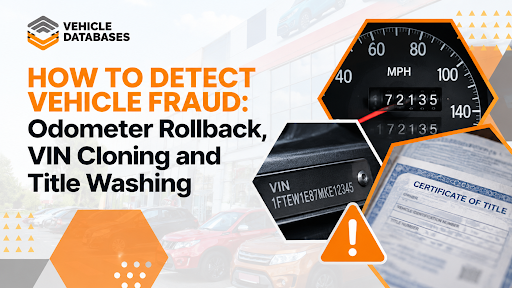
Vehicle fraud turns a vehicle’s paperwork into a liability for whoever lends against it, insures it, or buys it. Three schemes cause much of the damage: odometer rollback, VIN cloning and title washing. Each leaves traces in data, and automated checks can catch them before money changes hands.
The best public figures are from the US. NHTSA estimates that more than 450,000 vehicles are sold each year with false odometer readings, costing American consumers more than $1 billion annually (NHTSA, April 2018). That is NHTSA’s published estimate from 2018, so look for a newer one before you quote it in a sales document.
Theft is falling but remains large: NICB counted 659,880 US vehicle thefts in 2025, a 23% drop from 2024 and a historic low. Stolen vehicles are the raw material for VIN cloning, so even a low theft rate leaves a large supply that someone may try to re-identify.
This guide explains how each scheme works, the red flags in the data, where in your workflow to run the check, and what an automated fraud check should return. It is written for the lenders, insurers, leasing firms and fleet operators who carry the loss when a vehicle is not what it seems.
| Business | Where fraud hits | What they need |
|---|---|---|
| Auto lenders and finance companies | Loans secured by stolen, cloned or already-pledged vehicles | Collateral verification at underwriting |
| Insurers | Policies written on the wrong vehicle, claims on rolled-back or salvage vehicles | Identity and history checks at quote and claim |
| Leasing and rental companies | Fleet purchases and customer-supplied vehicles that are not what they seem | Intake checks and a record of each one |
| Fleet operators | Used vehicles bought with hidden damage or false mileage | History and mileage checks before purchase |
| Compliance and risk teams | Gaps in the audit trail when a case is disputed | Logged, repeatable checks tied to each decision |
| Marketplaces and dealers | Listings that hide a salvage brand or altered mileage | Pre-listing screening |
The Three Vehicle Fraud Schemes and How to Spot Them
Odometer rollback
How it works. The mileage shown on the dashboard, and often on the title, is lowered so a high-mileage vehicle sells, finances or insures as a low-mileage one. Lower mileage raises the vehicle’s value, so the lender or buyer overpays and the insurer misprices the risk.
Red flags in the data
- A mileage reading that is lower than an earlier reading for the same VIN
- Mileage that barely changes across several years of ownership
- Readings from service, inspection or auction records that conflict with the declared mileage
Red flags on the vehicle (from NHTSA’s consumer guidance): misaligned or loose odometer digits, pedal and tire wear that does not fit the mileage, and service stickers that show higher readings.
How to detect it at scale. Pull the vehicle’s mileage history by VIN and compare every reading in date order. A reading that moves backwards, or a gap that does not fit the vehicle’s age and use, is a flag.
VIN cloning
How it works. Per NICB, criminals copy the VIN of a legally owned vehicle onto counterfeit VIN tags for a stolen vehicle, then sell it with fake or falsely obtained ownership documents. The stolen vehicle carries a real, clean identity.
Red flags in the data
- The same VIN appears on two vehicles, in two places, or in two registrations at once
- The decoded specification (make, model, year, engine, body) does not match the vehicle presented
- A new or late-model vehicle with no lienholder, offered by a seller who says it is paid off
- A plate that resolves to a different VIN from the one on the documents
How to detect it at scale. Decode the VIN and compare the result field by field with what the applicant declared. Check for duplicate or conflicting registrations and run a theft check on the VIN and plate. A clean VIN that decodes to the wrong vehicle is the classic cloning signal.
Title Washing
How it works. A vehicle with a salvage, flood or total-loss brand is re-registered, often in another state or country, until the brand drops off and the title comes back “clean”. NICB describes dishonest dealers moving flood-damaged vehicles to other states to obtain a clean title.
Red flags in the data
- A recent title transfer across a jurisdiction line, especially after an insurance total-loss record
- A title brand in an earlier record that is missing from the current one
- Auction, salvage or insurance history that has no matching title brand
How to detect it at scale. Look at brand history across every registration, not only the current title. A washed title has a past that the present record does not show.
No single flag proves fraud. Legitimate vehicles are re-registered, replaced odometers do get recorded, and data has gaps. Score the flags together and route the case, as the next section shows.
READ ALSO: How to Check Car Title with VIN Number (Simple Guide)
Where Fraud Enters Your Workflow

Fraud reaches you at the moment you take on risk: funding a loan, binding a policy or accepting a vehicle into a fleet. The check belongs at that moment, so a flagged case is stopped or reviewed before money moves.
Fraud Detection Checks and the Data Behind Them
Each scheme needs a different data source. A fraud check works when it combines several of them in one response.
| Check | Scheme it Catches | Data it Uses | API |
|---|---|---|---|
| VIN validity and decode | VIN cloning, mistyped or invented VINs | Check digit, manufacturer specification by VIN | Vehicle History API |
| Mileage history comparison | Odometer rollback | Dated readings from service, inspection, auction and registration records | Odometer / Mileage History API |
| Theft and salvage lookup | VIN cloning, stolen vehicles, total-loss resales | Theft databases, insurance total-loss and salvage records | Stolen Car API & Salvage Check API |
| Title brand history | Title washing | Brands across every registration, not only the current one | Title Brand API |
| Open recall lookup | Compliance and safety exposure | Manufacturer recall campaigns by VIN | Recall API |
Two points matter when you design the workflow:
- Coverage differs by check and by country. A provider may decode VINs everywhere but hold odometer or title data in fewer markets. Ask for a coverage report for the markets you lend or insure in.
- “No record” is not “clean”. Treat a missing history as its own outcome, such as “unknown”, and decide per use case whether to review it or reject it.
Business Impact of a Fraud Detection Workflow
The return on fraud checks shows up in four places.
- Fewer fraudulent claims and loan defaults. A loan or policy that never gets written on a cloned, stolen or rolled-back vehicle is a loss avoided. This is the most direct and measurable return.
- Less manual review. Automated checks at underwriting, claims and onboarding clear the clean cases on their own. Reviewers see only flagged cases, with the evidence attached, instead of reading documents for every file.
- Audit-ready records. Each decision carries a logged check: what was queried, what came back and which rule fired. Compliance teams and regulators can reconstruct any case without relying on someone’s memory.
- Lower collateral and exposure risk. For lenders and lessors the vehicle is the security. Knowing it is real, unencumbered and correctly described keeps that security worth what you think it is.
How to measure the impact
Set a baseline before you switch checks on, then track the same metrics after.
| Metric | What it shows |
|---|---|
| Fraud-loss rate (losses per loans written or claims paid) | Whether fraud reaching the book is falling |
| Flag rate and confirmed-fraud rate among flags | Whether the rules are catching real fraud without too much noise |
| Review minutes per case | Time saved on manual work |
| Time to decision | Whether onboarding or underwriting is faster |
| Share of cases auto-approved | How much volume bypasses manual review safely |
| Disputed or reversed decisions | Whether the audit trail resolves cases quickly |
Vehicle Fraud Detection Integration example
A fraud check takes a VIN and the details the applicant declared, and returns one response covering every check.
Note: The endpoint, field names, and values below are illustrative.
Request
curl -X POST https://api.example.com/v1/vehicle/fraud-check \
-H “Authorization: Bearer YOUR_API_KEY” \
-H “Content-Type: application/json” \
-d ‘{
“vin”: “1HGBH41JXMN109186”,
“declared”: { “make”: “Honda”, “model”: “Civic”, “year”: 2021, “mileage”: 24000 },
“context”: “loan_underwriting”
}’
Response
					{
  "vin": "1HGBH41JXMN109186",
  "identity": {
    "vin_valid": true,
    "declared_match": false,
    "mismatch_fields": [
      "model"
    ]
  },
  "mileage": {
    "last_recorded": 61200,
    "last_recorded_date": "2025-03-14",
    "rollback_suspected": true
  },
  "theft": {
    "reported_stolen": false
  },
  "salvage": {
    "total_loss_record": true
  },
  "title": {
    "brands": [],
    "brand_history": [
      "salvage"
    ],
    "brand_dropped": true
  },
  "lien": {
    "active": false
  },
  "flags": [
    "declared_mismatch",
    "rollback_suspected",
    "title_brand_dropped"
  ],
  "risk": "high"
}
Routing logic
Your application turns the response into a decision. The rules stay in your code, so risk and compliance teams can change thresholds without a new integration.
REVIEW = {“declared_mismatch”, “rollback_suspected”, “title_brand_dropped”, “total_loss_record”}
def route(result):
if result[“theft”][“reported_stolen”] or not result[“identity”][“vin_valid”]:
return “reject”
flags = set(result[“flags”])
if flags & REVIEW or result[“risk”] in (“medium”, “high”):
return “manual_review”
return “approve”
In this example the vehicle goes to manual review: the declared model does not match the VIN, the mileage history moves backwards, and a salvage brand has disappeared from the current title. Any one of those could have an innocent explanation. Together they are a strong reason to look closer.
Store the full request, response, and decision for each case. That record is your audit trail.
Compliance and Audit Trail
A fraud check only holds up in a dispute or an audit if you can show what you checked and why you decided as you did.
What to log for every check
- The request: VIN or plate, declared details and the workflow stage (underwriting, claim, onboarding)
- The full response and the time it was returned
- The rule set and version that produced the decision
- The decision, who or what made it, and the reviewer’s notes if a person was involved
- The final outcome, so you can later measure which flags were real fraud
Privacy and automated decisions.
Ownership, lien and history data can be personal data. Follow the data protection law in each market you serve, such as GDPR in Europe and its regulations, and confirm retention periods and lawful basis with your counsel.
If an automated rule declines an applicant, check whether your jurisdiction requires an explanation or a human review.
Ask for a coverage report for your markets and test with vehicles you already know, including a few you expect to fail.
Get a Risk Assessment Today
Vehicle fraud is cheapest to stop before the loan is funded, the policy is bound, or the vehicle is onboarded. Start with the workflow where you lose the most, run the checks in parallel with your current process for a month, and compare what they catch against what your reviewers found.
Talk to sales for a risk assessment of your vehicle workflows and get started.
FAQs on Vehicle Fraud Detection
What is the difference between VIN cloning and title washing?
VIN cloning is basically identity theft for cars. Someone steals a vehicle, then slaps on the identity of a legitimate, clean-titled car so it looks totally legal. Title washing, on the other hand, is all about hiding a vehicle’s dirty past, usually after it’s been wrecked or flooded. They keep re-registering it across state lines until that nasty salvage or junk brand magically disappears from the current title.
Can odometer rollback be detected without inspecting the vehicle?
A lot of the time, yeah, you actually can. It comes down to comparing dated mileage records across service histories, state inspections, auction reports, & registration filings. If the mileage drops backward between dates, or sits virtually frozen across a long period, that’s a pretty big red flag right there.
The catch? It completely relies on having enough recorded history for that specific car. If a vehicle has a paper-thin history with almost no reported entries, you’re still going to need a physical inspection to be sure.
Does a clean history report mean the vehicle is safe to finance or insure?
Honestly, no. A clean report just means nothing bad was logged in the specific databases that provider actually checks. Unreported accidents, missing state records, or fresh VIN clones can slip right through undetected.
It’s best to treat a clean history report as just one piece of the puzzle, alongside a proper identity verification & the rest of your standard checks.
When should we run the checks?
Basically at every single point where you’re taking on risk. That means loan origination, policy quotes & claims, buying vehicles for a fleet, or onboarding cars onto a platform. Plenty of teams will also run a quick re-check when a policy comes up for renewal or when a loan gets refinanced.
Will automated checks create false positives?
Some. A replaced odometer, a legitimate re-registration or a data gap can all raise a flag. That is why flags route to manual review with the evidence attached, rather than rejecting automatically. Track the confirmed-fraud rate among flags and tune the rules.
Does this work outside the United States?
The schemes exist everywhere, but data coverage varies by country and by check. Ask your provider which checks are available in each market before you rely on them.