Insurance companies do not directly report to Carfax, but this doesn’t mean Carfax doesn’t get information on insurance claims and reports. While insurance companies do not report to Carfax directly, information on insurance claims and records may end up on Carfax through other channels.
Do insurance companies report to Carfax? Let’s find out more about how Carfax gets access to vehicle history.
Key Takeaways
- Does insurance report to CARFAX directly? In most cases, it does not.
- CARFAX accident information comes from several different reporting sources.
- A missing accident on a CARFAX report does not always mean no accident occurred.
Do Insurance Companies Report to CARFAX?
This is usually the first question people ask, and it deserves a straightforward explanation.
In general, do insurance companies report to CARFAX? No, they usually do not. Most insurance companies do not send accident or claim details directly to CARFAX. There is no nationwide requirement or shared system that forces insurers to upload claims into a CARFAX database.
Insurance companies keep claim records for their own internal purposes. Those records are designed for coverage decisions, payments, and legal documentation. They are not created for public vehicle history reports.
That said, insurance still plays an indirect role. If a claim leads to other official actions, those actions can generate records that CARFAX later receives.
Carfax Overview: What is Carfax?
Carfax is a widely recognized and trusted provider of vehicle history reports in the automotive industry. These reports are accessible with the VIN and offer valuable insights into a vehicle’s past, helping consumers and businesses make informed decisions when buying, selling, or maintaining vehicles.
In the used car market, Carfax and other vehicle history report providers hold great importance because they can help buyers verify a vehicle’s condition and avoid bad ones. They also help sellers and dealers have proof of their vehicle’s overall performance and condition.
However, sometimes consumers aren’t really happy with their reports, as they may end up reducing their trade-in values and overall value of their vehicles, sometimes even more than 10%. So, it causes a lot of them to wonder, Do insurance companies report to Carfax? No, but we will discuss this further in other sections.
How Carfax Collects Vehicle Information
So many people want to know what companies report to Carfax. Carfax says they get their information from 139,000 different sources across the US and Canada. They primarily gather vehicle history information from various sources such as state DMVs, police records, auto auctions, and service and repair facilities.
Who Reports to CARFAX?
Accident information usually comes from a few specific sources. Insurance companies are rarely the direct source.
Police departments and law enforcement agencies
When police respond to an accident and create a report, that information often enters state or national databases. CARFAX has access to many of those databases. This is one of the most common ways an accident ends up being recorded.
Insurance-related partners rather than insurers
Insurance companies work with third parties such as salvage processors, claims administrators, and auction platforms. When a claim results in a total loss or a vehicle being sent to auction, those third parties often report the event. CARFAX can then collect that data.
Repair facilities, body shops, and salvage auctions
Some repair shops share service and repair records. Salvage auctions almost always report vehicles that are declared total losses. These records often become accident entries.
This is why who reports accidents to CARFAX matters more than whether insurance was involved at all.
Other common Carfax data sources are:
- Motor vehicle agencies in the US
- Canadian provincial motor vehicle agencies
- Car Insurance companies
- Salvage auctions
- Automotive recyclers
- Rental/fleet vehicle companies
- State inspection stations
- Fire department
- Manufacturers
- Dealerships
- Import/export companies, and others.
READ ALSO: How Does Carfax Get its Information | Here’s the most Transparent answer
How an Accident Ends Up on CARFAX (Simple Flow)
Here is a simple way to think about the process.
First, an accident happens.
Two vehicles collide, or a car is damaged in some way.
Next, the incident is documented.
This could be through a police report, a repair shop invoice, a towing record, or a salvage or auction listing.
That organization then shares its data.
Many of these groups report information to regional or national databases that CARFAX monitors.
CARFAX collects the record.
CARFAX pulls the information from those partner sources and ties it to the vehicle’s VIN.
The accident may appear on the vehicle history report.
The next time someone runs the VIN, the accident can show up.
One important thing to remember.
If none of these steps happen, no report, no repair record, no official documentation, the accident may never appear on CARFAX.
How Long Does It Take for an Accident to Appear on CARFAX?
There is no guaranteed timeline.
Some accidents appear within days. Others take weeks. Some take months. Some never appear at all.
The timing depends on how quickly related records are processed and shared. Police reports, repair records, and auction data all move at different speeds. CARFAX can only display what has already been entered into those systems.
Do All Accidents Get Reported to CARFAX?
No, they do not.
Many accidents never show up on CARFAX reports. This is especially common when:
- No police report was filed
- Repairs were paid out of pocket
- Work was done at a non-reporting body shop
- Damage was minor and never formally documented
A clean CARFAX report simply means there is no reported accident. It does not mean the vehicle has never been damaged.
The Role of Insurance Companies in History Reports
While insurance companies don’t typically report directly to Carfax, their involvement indirectly impacts the information included in Carfax reports.
Handling Insurance Claims
When a vehicle is involved in an accident and an insurance claim is filed, the auto insurance company assesses the damage and facilitates the repair process.
During this process, the insurance company documents details of the accident, including the date, location, extent of damage, and any injuries sustained. This information is crucial for processing the damage claim and determining liability.
Record-Keeping
Insurance companies maintain detailed records of insurance claims, including information about the vehicles involved, the nature of the accidents, and the outcomes of the claims. These records are used for internal purposes such as claim processing, risk assessment, and underwriting.
Will insurance companies add a record to the Carfax if they only pay for the repair?
If the insurance company planned on reporting the repair to Carfax, they would even if you don’t get it repaired with their authorized shop. As long as there was a car accident and they wanted to report it, you’ll definitely find it on the Carfax report. Don’t forget the auto repair shop you use could also report the information to Carfax.
What triggers an "accident" report on CARFAX?
An accident report cannot appear on Carfax if the accident wasn’t reported in the first place. Here are some ways an accident can get reported:
- Police on the Scene: Accidents involving police reports are prime candidates for Carfax inclusion. These reports detail the crash and potential damage.
- Repair Shops: Body shops, especially large chains, may transmit collision repair data to Carfax. This can trigger an “accident” label.
- Severity Matters: Not all bumps get reported. Minor accidents, especially those settled privately with minimal damage, might fly under the Carfax radar and might come out with a clean Carfax report.
If you have a minor scratch, you can speak with the auto repair shops and find out if it would trigger an accident label with Carfax or any other vehicle history provider.
Now you understand how Carfax vehicle history reports contain accident records. While insurance providers don’t report accidents to Carfax directly, there’s a high chance that the records may get reported to Carfax.
What does an Accident Report look like?
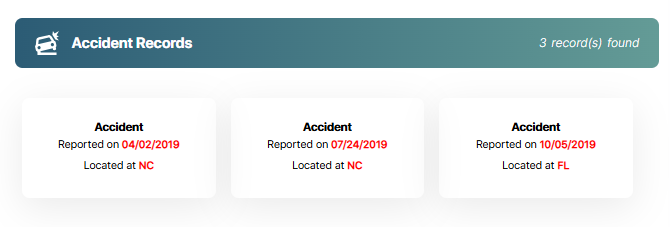
An accident report typically includes key details such as the number of accidents, date and location of the incident, a description of the damage, the severity of the accident (minor, moderate, or severe), airbag deployment status, and police involvement.
Here are a few sample reports to give you an idea:
Can Dealers and Businesses Access This Data Too?
Carfax gathers their information themselves. What if you could just gain full access to a database and provide accurate vehicle information to consumers?
Instead of relying on a finished report, businesses can pull raw vehicle history data using a Carfax API alternative and present it in their own format. This is how many platforms build their own history reports, inspection tools, and listing enhancements.
Common benefits include:
- Direct access to raw vehicle history data
- More control over how reports are presented
- Easier integration with dealer tools and marketplaces
For businesses that need vehicle history at scale, our APIs provide an alternative to third-party reports. We offer 15 credits to new, registered users, and you can book a demo at any time. Get detailed reports today!
Frequently Asked Questions on CARFAX Accident Reporting
Which insurance companies report to CARFAX?
Insurance companies generally do not report accident or claim data directly to CARFAX. Large insurers keep claim records internal. When insurance-related information appears on a CARFAX report, it usually comes from police reports, repair facilities, salvage processors, or auction records connected to the claim, not from the insurer itself.
How can I find out if an accident was reported to CARFAX?
The only way to confirm this is to run a CARFAX report using the vehicle’s VIN and review the accident or damage history section. If nothing appears, it means no accident was reported to CARFAX, not necessarily that no accident occurred.
Do body shops report to CARFAX?
Some body shops report repair data to CARFAX, but many do not. The repair facilities that operate as large chains and the body shops that work with insurance companies tend to report their repair activities, while independent body shops choose not to do so.
Can a dealership hide an accident from CARFAX?
No, a dealership cannot remove or alter an accident record that already exists on CARFAX.
Is it illegal to not report an accident to CARFAX?
No, it is not illegal. There is no law that requires accidents, repairs, or insurance claims to be reported to CARFAX. CARFAX is a private reporting service, and participation is voluntary.
How does CARFAX get accident reports?
CARFAX does not go looking for accidents. It does not investigate crashes or pull claim files from insurance companies. It gathers information that already exists in other systems, such as police records, repair logs, and auction listings, and connects those records to a vehicle’s VIN when they are available.