
The Best NHTSA VIN Decoder API Alternative
Looking for a more complete alternative to the NHTSA VIN decoder API? Vehicle Databases offers deeper VIN coverage, better accuracy, and business-ready vehicle data built for real automotive use cases.
What Is the NHTSA VIN Decoder API?
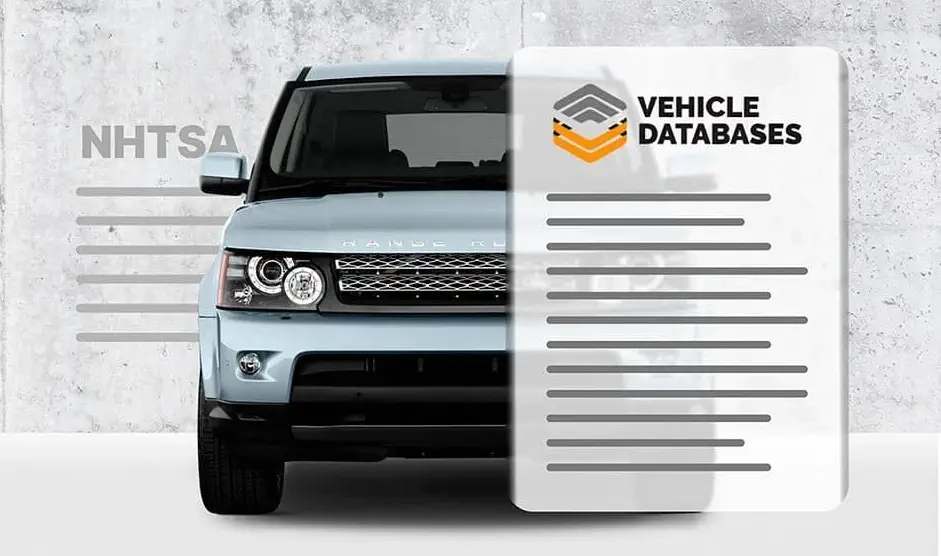
The NHTSA VIN decoder API is a public vehicle data service provided by the U.S. government through the National Highway Traffic Safety Administration. It decodes VINs and returns basic details such as year, make, model, engine type, body class, and manufacturer information.
The API is primarily built for safety programs, recalls, and regulatory reporting, using manufacturer-submitted data for standard 17-character VINs. It works well for simple lookups, but businesses with ongoing VIN data needs often require more depth and consistency.
Why Businesses Look for an NHTSA VIN Decoder API Alternative
On paper, the NHTSA API sounds ideal. It is free, government-backed, and easy to access. In practice, many automotive businesses outgrow it fast.
Let’s walk through the main reasons why.
Limited Data Depth
The NHTSA VIN decoder API prioritizes regulatory fields and manufacturer-submitted records, often resulting in minimal trim resolution for closely related vehicle variants.
Inconsistent Trim Accuracy
Since manufacturers do not always report trim details the same way, results may be missing, unclear, or inconsistent across similar vehicles.
Narrow Vehicle Coverage
The API works best for newer U.S. passenger vehicles and offers weaker coverage for classic, heavy-duty, motorcycle, and non-U.S. vehicles.
Not Built for Commercial Scaling
According to the NHTSA VIN decoder API documentation, the service is a public, shared API and does not provide predictable rate limits, performance guarantees, or commercial SLAs.
Vehicle Databases VIN Decoder API: A Better NHTSA Alternative
The Vehicle Databases VIN Decoder API was built specifically to solve the gaps left by government VIN tools. While NHTSA focuses on safety reporting, Vehicle Databases focuses on accuracy, coverage, and business usability.
This is not just another NHTSA VIN API extension. It is a fully independent VIN decoding system designed for modern automotive platforms.
What Makes Our API Different?
Vehicle Databases VIN Decoder API delivers:
Deeper trim-level resolution
Identifies trims and configurations more precisely when the data allows.
Support for modern and classic VINs
Decodes both standard 17-digit VINs and older VIN formats from 5 to 14 characters.
Multiple decoding levels
Lets you choose between basic and more detailed VIN data depending on your needs.
Error detection and correction
Flags invalid VIN entries and helps reduce failed or incomplete lookups.
Broader vehicle type coverage
Supports cars, trucks, SUVs, motorcycles, and additional vehicle categories.
Structured, predictable responses
Returns consistent, well-organized data that is easy to integrate and maintain.
Choosing the Right VIN Decoding Level
Not every business needs the same depth of VIN data. That is why Vehicle Databases offers flexible VIN decoding levels, allowing you to choose the amount of detail that fits your workflow.
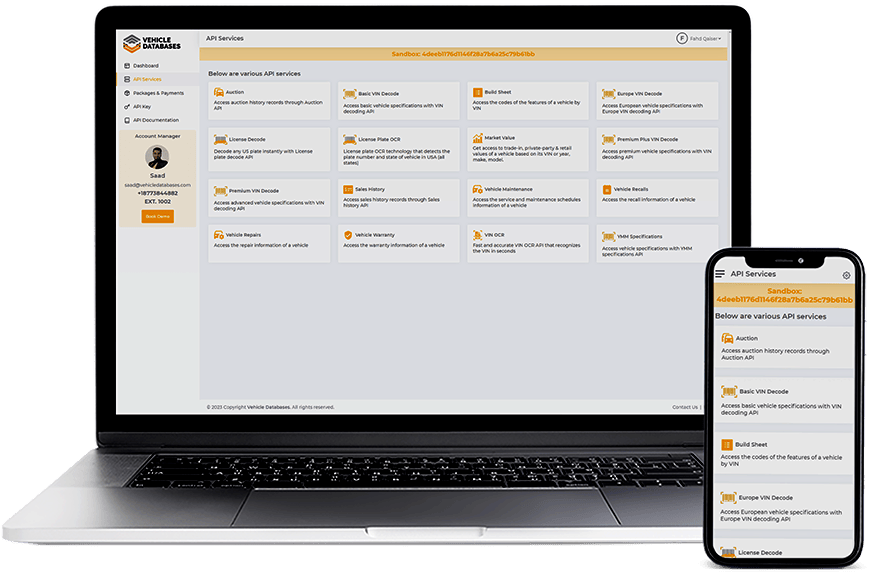
Basic VIN Decoder API
Basic decoding includes:
- Year
- Make
- Model
- Manufacturer information
- Basic body type
- High-level engine details
This level is best suited for VIN validation and simple inventory listings.
Premium Plus VIN Decoding
Premium Plus decoding includes:
- Accurate trim identification
- Engine configuration and fuel type
- Transmission details
- Drivetrain information
- Body style, doors, and seating
- Market-specific attributes
- Extended technical metadata
This level is designed for platforms that require detailed, configuration-level vehicle data.
Who This API Is Built For
The Vehicle Databases VIN Decoder API is designed for businesses that rely on accurate vehicle data as part of their daily operations, not just occasional lookups.
It is commonly used by:
Dealerships and online marketplaces
To auto-fill listings, reduce trim errors, and speed up inventory creation.
Insurance platforms
To verify vehicle configurations for underwriting, eligibility checks, and pricing logic.
Fleet and rental companies
To standardize vehicle records across mixed fleets and model years.
Automotive software and data providers
To power apps, tools, and platforms that depend on reliable VIN-based vehicle information.
Financial institutions and lenders
To validate vehicle details during loan approvals, asset valuation, and risk assessment.
Parts and service businesses
To match vehicles correctly using engine, drivetrain, and body configuration data.
Unique Properties of the Vehicle Databases VIN Decoder API
Vehicle Databases is built around real automotive workflows. The goal is not just to decode a VIN, but to return data you can actually rely on. Here’s what truly makes us stand out from others:
Easy Integration and Usage
Auto businesses can seamlessly integrate the API into their software and web applications. Additionally, they can easily retrieve detailed information about a vehicle by entering its VIN.
Extensive Coverage
The API covers all car makes and models, including classic cars, thanks to the Vehicle Databases classic decoder API.
AI-Powered Accuracy
The API uses AI technology to analyze data accurately, ensuring reliable results without false information.
Multiple Sources and Data Points
The API decodes VINs from multiple trusted sources and returns over 200 data points for each VIN.
Multiple Auto Business Applications
Several auto businesses like dealerships, insurance companies, classified sites, parts manufacturers and suppliers, and repair and servicing shops can effortlessly integrate the VIN decoding API to provide their users with accurate and detailed vehicle information.
Detective Tool
In the complex web of automotive technology, the API emerges as a perfect detective tool, holding the key to unlock hidden information embedded within a car VIN (vehicle identification number).
Constant Updates
The API is constantly updated with new vehicle data. Auto businesses can confidently rely on the API for accurate and up-to-date details about vehicles.
Flexible Formats
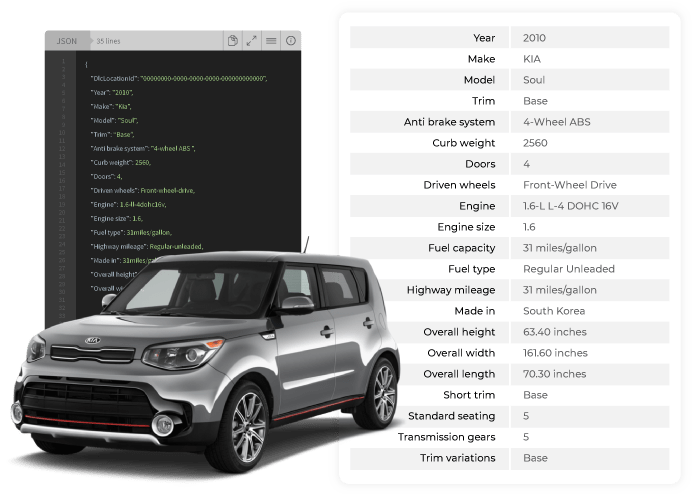
The VIN decoding API returns data in formats like JSON, and HTML.
Vehicle Databases vs NHTSA VIN Decoder API
| Feature | NHTSA VIN Decoding API | Vehicle Databases VIN Decoding API |
|---|---|---|
| Range of VIN Decoding | Primarily designed for 17-digit VINs, limiting its scope. | Versatile decoding, accommodating VINs of varying lengths, including classic VINs, with varying lengths from 5 to 14-digit VINs. |
| Vehicle Coverage | Lacks the breadth to cover motorcycles and heavy-duty vehicles. | Encompasses a broad spectrum, decoding VINs for cars, trucks, SUVs, motorcycles, and vehicles of all weight classes. |
| Error Detection and Correction | May not provide suggestions or corrections for input errors. | Not only detects errors but also suggests correct VINs, ensuring accuracy in decoding. |
| Partial VIN Decoding | Limited ability to decode partial or incomplete VINs. | Excels in decoding partial VINs, enhancing flexibility in information retrieval. |
| Trim Accuracy | May lack precision in translating VINs to exact trims. | Utilizes advanced decoding technology, ensuring the highest accuracy in determining exact trims. |
| VIN Decoding Type | Offers only the basic VIN decoding. | Offers two VIN decoding types—Basic and Premium Plus—for detailed vehicle information. |
Need More Than VIN Decoding? Check out Other APIs!
Many businesses start with VIN decoding, then quickly realize they need additional vehicle data. Vehicle Databases offers several complementary APIs that integrate seamlessly with VIN decoding.
Access detailed technical specifications, including dimensions, engine configurations, drivetrain options, and feature availability.
Retrieve ownership events, title changes, damage indicators, theft records, and usage patterns where available.
Access vehicle information using license plate numbers when VINs are not available.
Estimate vehicle pricing and market trends using decoded VIN attributes.
Add recall and safety-related data in a format built for business use.
Retrieve reference images tied to specific makes, models, years, and trims.
Why Choose the Vehicle Databases VIN Decoder API?
Choosing a VIN decoder is not just a technical decision. It affects pricing accuracy, customer trust, and operational efficiency.
Vehicle Databases stands out because it offers:
- Extended Coverage: The API gives a more thorough VIN decoding process and includes both modern and classic VINs.
- User-Friendly Interface: The API is built keeping simplicity at its core and is made to be user-friendly for everyone regardless of their technical background.
- Cost-Effective Solution: Vehicle Databases data is an alternative that is cheaper than other providers’ solutions for obtaining accurate vehicle information.
It is built for businesses that cannot afford guesswork.

What Our Clients Saying About Us?


The Future of VIN Decoding Starts Here
The automotive industry is moving fast. Data accuracy matters more than ever. If you are relying on the nhtsa vin lookup alone, you are likely missing critical details that impact decisions downstream.
Vehicle Databases provides a future-ready alternative that grows with your needs.
FAQ About the NHTSA VIN decoder API Alternative
Is the NHTSA VIN decoder API free to use?
Yes, the NHTSA VIN decoder API is free to use and does not require an API key. It is provided as a public service by NHTSA.
How do I get an API key for NHTSA's database?
The NHTSA VIN API does not require an API key for its usage. It is very easy to communicate with the public endpoints directly, which is the way the NHTSA VIN decoder API documentation specifies for sending requests.
What data does the Vehicle Databases NHTSA VIN decoder API provide?
The Vehicle Databases VIN Decoder API returns core identification data such as year, make, and model, along with detailed trim resolution, engine and transmission specifications, drivetrain layout, body style, seating and door configuration, manufacturer details, and additional technical attributes based on the decoding level selected.
How accurate is the NHTSA VIN decoder compared to commercial ones?
The NHTSA VIN decoder is accurate for basic vehicle identification but often lacks trim-level precision. Commercial solutions like Vehicle Databases typically offer higher accuracy due to enriched data sources and advanced resolution logic.
What's the rate limit for the NHTSA API?
NHTSA does not publish strict rate limits, but performance may vary under heavy usage since the service is shared and public.
Does the NHTSA API alternative include recall information?
Yes. Vehicle Databases provides a dedicated Vehicle Recall API that delivers recall and safety-related data and works alongside VIN decoding.
How do I use the NHTSA VIN decoder API in my application?
You send a VIN via an HTTP request to the decode endpoint and parse the JSON or XML response. For production use, many developers choose a commercial alternative for stability and accuracy.
What's the difference between NHTSA's API and a paid VIN decoder API?
The main difference between the NHTSA API and a paid VIN decoder API is depth and reliability. Paid VIN decoder APIs provide better trim accuracy, broader coverage, error handling, and consistent performance suitable for business applications.
Can I get crash test ratings through the NHTSA API alternative?
Yes, crash test ratings can be obtained using the Vehicle Databases VIN Decoder API instead of the NHTSA API. If crash test data is present for a particular VIN, the API will send the safety and rating info as part of the decoded vehicle data.