In short
- Verification answers three questions: identity (is this the vehicle it claims to be?), history (what has happened to it?) and ownership (who is entitled to sell, insure, finance or operate it?).
- A single plate or VIN can trigger all three checks through an API in seconds, replacing document uploads and manual review.
- The return on investment shows up as faster onboarding, fewer fraudulent claims and loan defaults, and lower liability.
When a business accepts a vehicle onto its platform, how does it really know the details are actually correct? A driver might type in the wrong license plate, a seller might enter an incorrect model year, or the vehicle’s background records just don’t match what was provided.
That kind of thing usually ends up causing annoying delays during onboarding, inaccurate listings, and a whole lot of extra work for your team. This is exactly where vehicle verification comes in to do the heavy lifting.
Basically, vehicle verification lets companies figure out the exact make and model of a car, compare that to what’s on file, and spot any weird red flags that need a closer look. It makes day-to-day checks way simpler for ride-hailing apps, car rental fleets, and online marketplaces.
In this guide, we’ll explain how vehicle verification works, which checks businesses may need and how automotive data APIs can help automate the process.
What Is Vehicle Verification?
Vehicle verification involves inspection of a vehicle’s identity and comparison of existing records against details provided by a driver, seller, or owner.
Based on the business, this may involve:
- VIN Verification: Verify the Vehicle Identification Number (VIN) against the data records of the vehicle.
- Search by license plate: Check by registration plate to find vehicle data or roll back the plate to a VIN if possible.
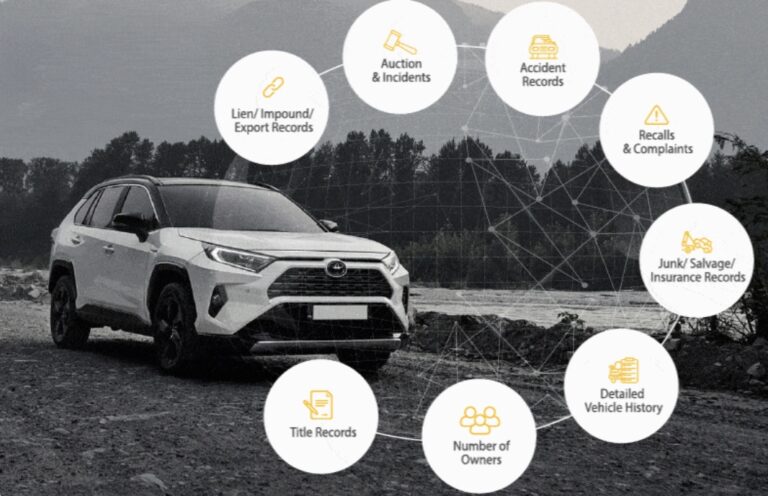
- Vehicle history searches: Checking for any available accident, title brands, theft, and odometer records.
- Register and ownership verification: Validating relevant data through official sources where appropriate.
- Vehicle documentation check: Verification of submitted vehicle documents and information obtained from relevant sources.
They address various concerns. For example, just because a VIN number matches does not mean it is legitimately owned, and if a vehicle history report has no report of accidents, it does not mean it has never been damaged.
The right checks depend on what your business needs to confirm and what information is available for the vehicle.
READ ALSO: How to Check Car Title with VIN Number
Why Vehicle Verification Matters for Auto Businesses
Vehicle verification is about more than just keeping data consistent and up-to-date. Verification is about optimizing all business operations from customer onboarding to decision making, including removing the repetitive, non-value add work for the employees. The top reasons why vehicle verification matters are:
1. Optimizing Driver and Vehicle Onboarding
Every driver verification solution and ride sharing / food delivery / grocery delivery / courier platforms need a verification solution for their drivers as well. So do rental car platforms for the drivers using their vehicles, especially during driver vehicle onboarding.
The manual work of reviewing the driver and vehicle verification documentation, along with the manual work of verifying and searching across separate databases, takes time and results in slow onboarding.
When verifications are automated, the platform would receive the VIN and license plate number, from which they could pull and automatically verify against the driver application to let the application move to the next status or flag it for manual review.
This results in less time spent performing routine verification tasks and more time on applications that need attention.
2. Better Vehicle Listings
As online marketplaces and private sellers become more dominant in vehicle sales, so do the opportunities to improve the listing accuracy. A seller might mistakenly list a car as being a different model year, a different trim level, or input details that contradict the VIN.
A VIN lookup can help the marketplace compare submitted details with available vehicle specifications before publishing the listing.
Should something not be right, the platform could prompt the seller for corrections, or the marketplace could simply review the listing. Although not 100% perfect, this will decrease avoidable listing issues.
3. Better Risk Screening
Often, vehicles have records like reported thefts, or they may have branded titles or odometer discrepancies. A vehicle history API allows companies to pull all of these records and examine them, which helps businesses be more aware of possible concerns.
Keep in mind that missing records don’t prove a vehicle has no problems. Verification provides additional information, not a guarantee against fraud.
READ ALSO: How to Check if a Vehicle Is Stolen Before You Buy or Sell
4. Lower Manual Review Costs
Every platform will grow to a point where inspecting each vehicle will be both costly and time-consuming.
Common examples include searching for a vehicle’s specifications, comparing information from VIN to history reports, or retrieving available history reports. APIs can take care of the mundane and repetitive tasks while employees focus on cases that have conflicting or no information.
This isn’t about eliminating human review altogether. It’s about allowing you to focus on the reviews a system is unable to do accurately and reliably.
How Does Vehicle Verification Work
A typical vehicle verification process follows five steps.
- Collect vehicle information. An insurer, driver, or owner offers a VIN, license plate number or other information.
- Retrieve vehicle information. The platform transmits the VIN to a relevant API and receives the data available.
- Compare the results. The system checks whether details such as the VIN, make, model, and model year match the submitted information.
- Flag discrepancies. Matching details can proceed, while conflicting or missing information may require additional checks.
- Record the outcome. The result and any unresolved issues are stored by the system and can be reviewed later.
For example, a delivery platform could check a driver’s submitted VIN against vehicle details retrieved through an API. If the information matches, the application moves forward. If the details conflict, the platform can request clarification or send the case to an employee.
Which Vehicle Verification APIs Do Businesses Need?
You don’t necessarily need every available API. Start with the information your business collects and the decisions it needs to make.
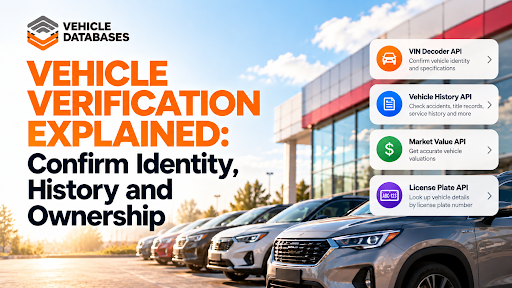
| API | What it helps verify | Common use cases |
|---|---|---|
| VIN Decoding API | Whether a VIN matches available vehicle details | Onboarding, listings, and fleet records |
| License Plate Lookup API | Vehicle details associated with a plate, including plate-to-VIN matching where supported | Rental, delivery, and fleet operations |
| Vehicle History API | Available accident, title, theft and odometer records | Marketplaces and risk screening |
| Registration/Ownership Check API | Relevant registration or ownership information where authorized sources provide it | Finance, rental and fleet compliance |
| Vehicle Specifications API | Make, model, year, and other supported specifications | Listing validation and vehicle databases |
A marketplace might start with VIN decoding and plate lookup to improve listing accuracy. A lender or rental company may need additional history or registration checks.
Before integrating an API, check its coverage. Available fields vary by provider, country, vehicle type, and data source. Also confirm that you have the necessary authorization to access and use the records.
How Vehicle Verification APIs Help Different Industries
Here’s an example of some popular industries that leverage vehicle verification APIs:
Ride-Hailing and Delivery Platforms
These platforms need to associate each driver account with the correct vehicle. A license plate lookup API can retrieve available vehicle details, while VIN verification can help compare the submitted identifier with the expected vehicle.
Further history or registration searches could be beneficial when accessible and permitted.
Business benefit: reduced time to complete routine checks and improved consistency of driver onboarding.
Car Rental and Car-Sharing Companies
Rental businesses need accurate vehicle records for inventory management, maintenance and vehicle handovers. Incorrect identifiers can create problems across these processes.
Automated verification can compare details submitted against vehicle information that was actually recorded when the vehicle was added to the fleet, or when updating existing fleet records.
Business benefit: Fewer data-entry errors and more reliable fleet records.
Online Marketplaces
Marketplaces need to make listing vehicles as easy as possible without accepting every submitted detail at face value.
A verification workflow can compare seller-provided information with available vehicle specifications and flag discrepancies before publication. Vehicle history checks can also be done for buyers when applicable records are available.
Business benefit: Better listing accuracy and reduced unnecessary conflict.
Fleet Operators
Fleet operators may manage vehicles across several locations or departments. Incorrect vehicle identifiers can complicate maintenance scheduling, reporting and record management.
VIN verification and decoding can help establish consistent vehicle records and reduce repeated manual entry.
Business benefit: Cleaner data and less administrative work.
Banks and Vehicle Finance Providers
Lenders may need to check the make and model of the vehicle to make sure they have the right data when reviewing applications or assessing collateral. Vehicle specifications and available history records can help identify discrepancies in the information supplied.
These checks should supplement the lender’s overall review process and not be used as a substitute for the lender’s underwriting or legal checks.
Business benefit: More accurate vehicle information when reviewing applications.
Vehicle Verification vs. VIN Checks vs. Vehicle History Reports
These terms are related, but they aren’t interchangeable.
| Check | Main purpose | What it doesn't automatically prove |
|---|---|---|
| Vehicle verification | Compare submitted vehicle details with available records | Legal ownership or a clean history |
| VIN decoding | Identify a vehicle and retrieve supported specifications | Whether the vehicle has been stolen or damaged |
| License plate lookup | Retrieve vehicle details associated with a plate | That the plate is currently valid or legally assigned |
| Vehicle history report | Review available records of reported events | That every event has been reported |
| Registration or ownership check | Check information available from an authorized source | That all records are current or complete |
For example, a VIN lookup may correctly identify a vehicle’s make and model, but the vehicle could still have a reported theft record. A business that needs to check both identity and history may therefore require more than one service.
The important thing is to choose checks that answer the questions your business needs to resolve.
Common Vehicle Verification Challenges
Even with access to vehicle data, there are still a few pitfalls, that can make verification more difficult:
- Incomplete records: Sometimes a lookup brings back basic vehicle specs, but the registration info is completely missing. It’s important for businesses to tell the difference between data that’s just missing and an actual, confirmed mismatch.
- Incorrect identifiers: A user may enter the wrong VIN or submit a plate that doesn’t match the stated vehicle. Data lookup can sometimes find some of these mismatches, but they may require physical inspection or documentation.
- Different country coverage: An API may have a good deal of data in one country and minimal data in another. Be sure to look at coverage before setting up your workflow around an API.
- False positives: A mismatch doesn’t always mean fraud. It could result from a typing error or incomplete record, so uncertain cases may need manual review.
- Privacy requirements: There may be restrictions to view registration and ownership data. Ensure you are authorized to access the information and to comply with data privacy requirements.
How to Choose a Vehicle Verification API Provider
Before integrating a provider, consider these five points:
- Data coverage: Check supported countries, vehicle types and data fields.
- Available information: Confirm that the API returns the details your application actually needs.
- Integration requirements: Review authentication, documentation, response formats, rate limits, and error handling.
- Data freshness: Ask how often relevant records are updated and understand the limitations of each source.
- Pricing and scalability: Estimate your expected request volume and compare pricing, limits, and support options.
It’s also worth testing the API before moving to production. Check how it handles missing information, conflicting details, and unsuccessful requests so your system can respond appropriately.
Automate Vehicle Verification with Vehicle Databases APIs
Vehicle Databases offers APIs for automotive data that can be included into your applications and workflows.
Based on your use case and available coverage, you could; use VIN-based vehicle information to verify the submitted information, use a License Plate Lookup API to obtain supported vehicle information, and use a Vehicle History API to view the available records.
Where authority sources supply data required, it may be possible to corroborate registration and ownership checks.
These services also support: onboarding forms, marketplace listings, fleet systems and other business applications. Your app can verify returned details and identify mismatches, then record the results on the platform using its own validation rules.
Would you like to test how vehicle verification is implemented in your application? Sign up for a sandbox trial, read the API documentation, and test the services relevant for your business.
FAQs About Vehicle Verification APIs
What is vehicle verification?
Vehicle verification is the process of verifying information of a vehicle and cross-checking this information with any other available records. It might encompass VIN checks, license plate lookup, vehicle history checks, and registration checks based on what information is available.
Can you verify a vehicle using its license plate number?
Yes, if a license plate lookup service has the vehicle and registration market. With Vehicle Databases License plate API, the plate is matched to the VIN and returned, along side other vehicle specifications.
What is the difference between VIN verification and a vehicle history check?
VIN verification helps confirm whether a VIN matches available vehicle details. A vehicle history check looks for reported events associated with the vehicle, such as accidents, title brands, theft records or odometer discrepancies. Businesses may use both checks when they need to verify vehicle identity and review its available history.
Which businesses can benefit from vehicle verification APIs?
Automated vehicle checks are useful for ride-hailing and delivery companies, car rental providers, online marketplaces, fleet operators, and vehicle finance providers. Reducing data errors, avoiding duplicated administrative work, and standardizing processes for onboarding, screening, and vetting are just some of the benefits.